EN
EN
What is Aluminum Profile and How Does It Work?
2026/09/30
Source aluminum profiles for versatile modular framing. Learn extrusion mechanics, strength benefits & corrosion resistance. Request details.

2026/08/20
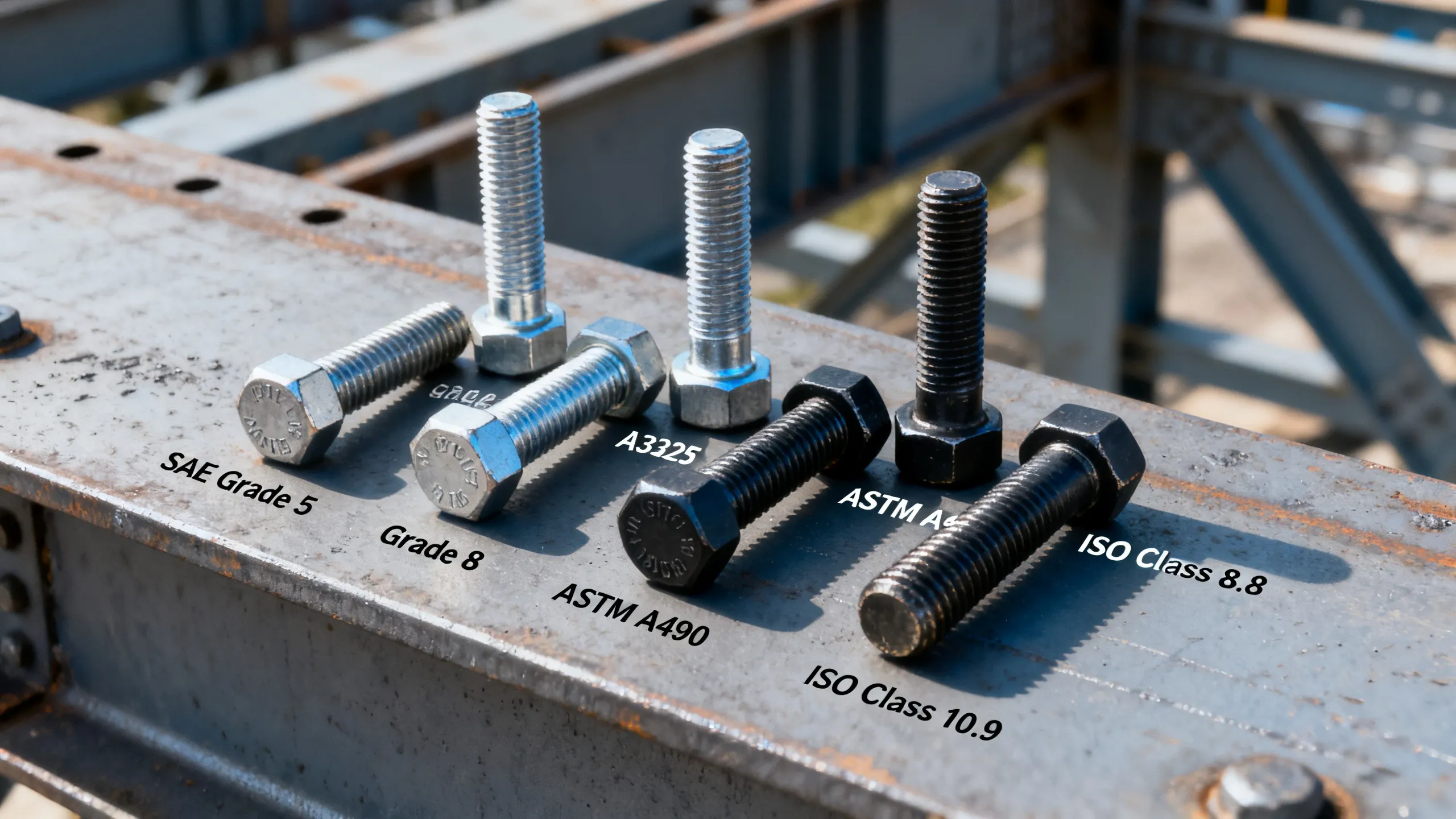
Selecting the correct bolt grade is a critical engineering decision—not just for safety and regulatory compliance, but for long-term structural integrity, maintenance cost, and lifecycle performance. In structural steel connections, bridges, wind turbine towers, and heavy industrial frameworks, using an under-specified or over-engineered fastener can lead to catastrophic failure or unnecessary expense. This guide cuts through industry confusion by comparing key mechanical properties, material compositions, coating requirements, and application-specific suitability across five globally recognized bolt grades: SAE Grade 5 and Grade 8, ASTM A325 and A490 (U.S. structural standards), and ISO 898-1 Classes 8.8 and 10.9 (widely adopted in EU, Asia, and international projects). We emphasize practical selection criteria—tensile strength, yield-to-tensile ratio, corrosion resistance, heat treatment, and code-mandated usage—so engineers, procurement specialists, and project managers can make confident, standards-aligned decisions.
Bolt grades are standardized nomenclatures that communicate minimum mechanical properties—not dimensional or thread specifications. While SAE grades dominate general-purpose automotive and machinery applications, ASTM and ISO standards govern structural and high-load environments where proof load, ductility, and notch toughness are rigorously tested. For example, ASTM A325 bolts are specifically designed for structural steel joints and require controlled heat treatment (quench-and-temper) and mandatory mechanical testing per ASTM F3125. Similarly, ISO 898-1 Class 10.9 bolts must meet strict tensile strength (≥1000 MPa) and elongation (≥9%) thresholds to ensure reliable preload retention under dynamic loading.
Three interdependent factors drive optimal bolt grade selection:
The table below compares six widely used structural bolt grades across four essential selection dimensions. All values reflect minimum specified requirements per current editions of ASTM F3125 (2023), ISO 898-1 (2013), and SAE J429 (2022).
| Property | Grade 5 (SAE) | Grade 8 (SAE) | ASTM A325 | ASTM A490 | ISO 898-1 Class 8.8 | ISO 898-1 Class 10.9 |
|---|---|---|---|---|---|---|
| Yield Strength (MPa) | 620 | 860 | 675–830* | 950–1090 | 640 | 940 |
| Tensile Strength (MPa) | 860 | 1160 | 830–1040 | 1100–1220 | 800 | 1000 |
| Material | Medium carbon steel | Alloy steel | Carbon or alloy steel | Alloy steel (incl. boron) | Carbon or alloy steel | Alloy steel |
| Typical Coating | Zinc plating | Cadmium or zinc | Hot-dip galvanized or mechanical galvanized | Uncoated or waxed (galvanizing prohibited) | Zinc or phosphate | Zinc or black oxide |
| Primary Application Suitability | General machinery, non-structural | High-stress automotive, equipment | Structural steel framing (US), bridges | Heavy structural, high-preload connections (US) | EU structural, machinery, rail | High-performance structures, aerospace, power generation |
*A325 yield range varies by type (Type 1: carbon; Type 3: weathering steel). A490 is prohibited for use in atmospheres with pH < 4.5 or chloride exposure > 200 mg/m²/day due to stress corrosion cracking risk.
Always verify local building codes (e.g., AISC 360, EN 1993-1-8) and project specifications before finalizing bolt grade. Key recommendations include:
Can I use Grade 8 bolts instead of ASTM A325 in structural applications?
While Grade 8 bolts exhibit higher tensile strength, they lack the mandatory ductility testing, rotational capacity verification, and controlled hardness range required by ASTM F3125 for structural steel connections. Substituting without engineering approval violates AISC 360 provisions and may void project insurance coverage.
What is the difference between ISO 8.8 and ASTM A325 bolts?
Both grades target similar strength ranges, but they differ in dimensional tolerances, thread engagement specifications, and proof load testing protocols. ISO 8.8 bolts conform to metric sizing under ISO 4014/4017, while A325 bolts follow inch-based ASME B18.2.6 geometry. Cross-referencing requires careful evaluation of shank diameter, thread pitch, and bearing area compatibility.
How does galvanizing affect bolt performance?
Hot-dip galvanizing per ASTM A153 provides excellent atmospheric corrosion resistance for A325 bolts but increases hydrogen embrittlement susceptibility in higher-strength fasteners. ASTM A490 and ISO Class 10.9 bolts should never be hot-dip galvanized—alternative coatings like mechanical zinc plating or PTFE-based lubricants are recommended for corrosive service environments.
Where to buy certified structural bolts?
Always source high-strength structural fasteners from ISO 9001-certified distributors who provide full mill test reports, lot traceability, and compliance documentation aligned with your project's governing specification.
Choosing the right bolt grade is not merely about matching strength numbers—it’s about aligning material science, manufacturing control, environmental resilience, and regulatory compliance into a single, mission-critical component. Whether specifying for a U.S. bridge project governed by AISC or an offshore wind farm adhering to EN 1090-2, understanding the functional distinctions between Grade 5, Grade 8, ASTM A325/A490, and ISO 898-1 Classes 8.8/10.9 ensures structural reliability, avoids costly rework, and supports sustainable infrastructure development. For detailed technical datasheets, certified test reports, or application engineering support, contact our structural fasteners team today.
2026/09/30
Source aluminum profiles for versatile modular framing. Learn extrusion mechanics, strength benefits & corrosion resistance. Request details.
2026/09/30
Source aluminum profiles for construction projects. Learn structural framing, cladding & window benefits for maximum ROI. Download guide.
2026/09/30
Source optimal aluminum profile sizing techniques. Evaluate load, space, alloy, environment & cost factors to prevent deflection. Download guide.
2026/09/30
Struggling with fastener failures or rework? Master screw sizing by diameter, pitch, material, and load—plus industry-specific standards. Optimize reliability & compliance now.
2026/09/30
Source aluminum profiles for industrial engineering. Discover strength-to-weight ratios, corrosion resistance & 30% cost savings. Download guide.
2026/09/30
Source heat-resistant aluminum profile systems. Master thermal expansion science & stress management strategies for industrial builds. Download guide.